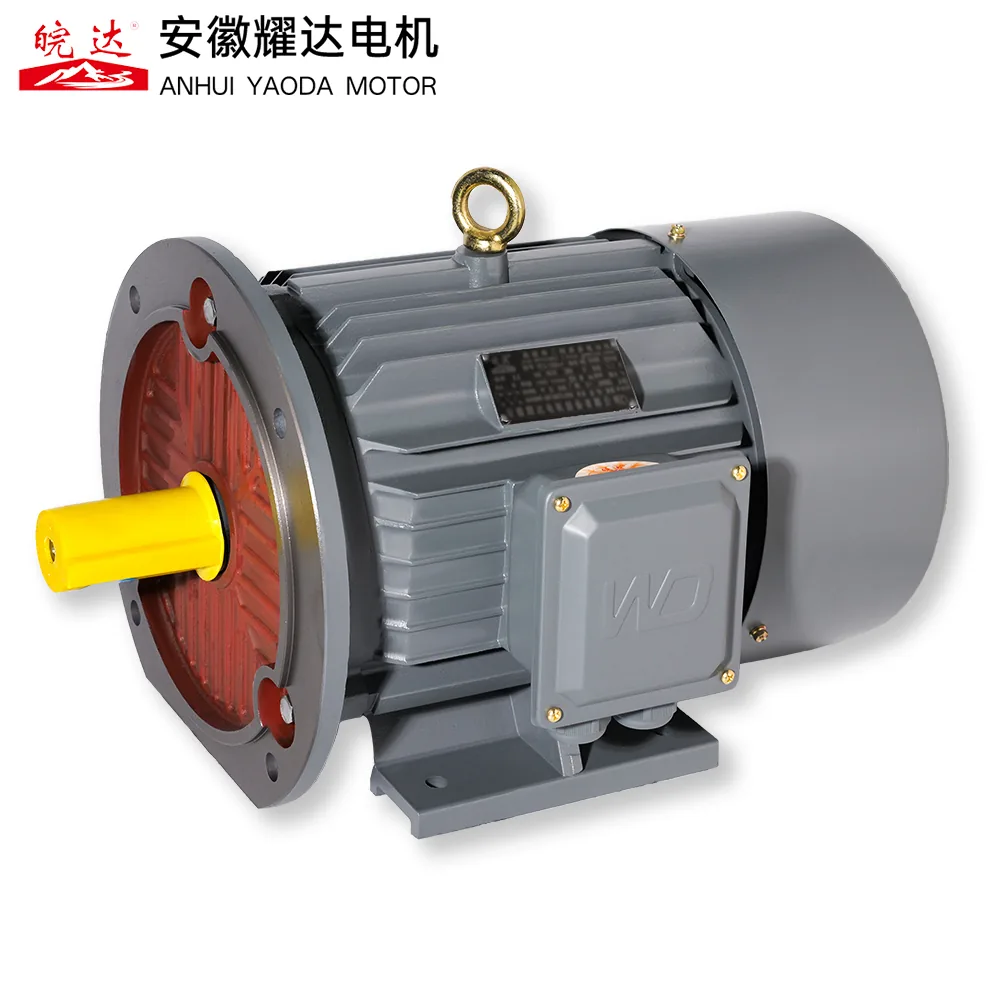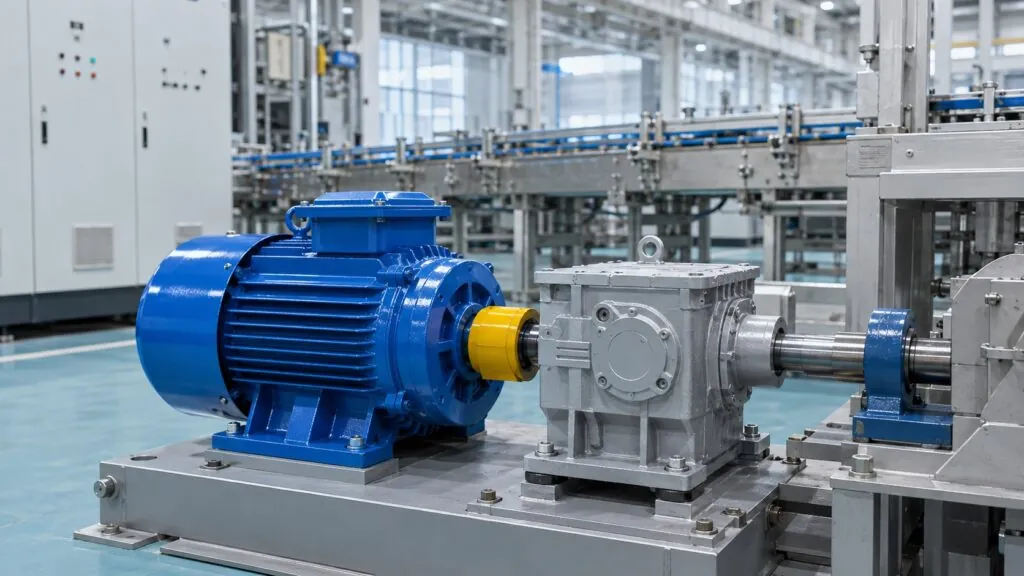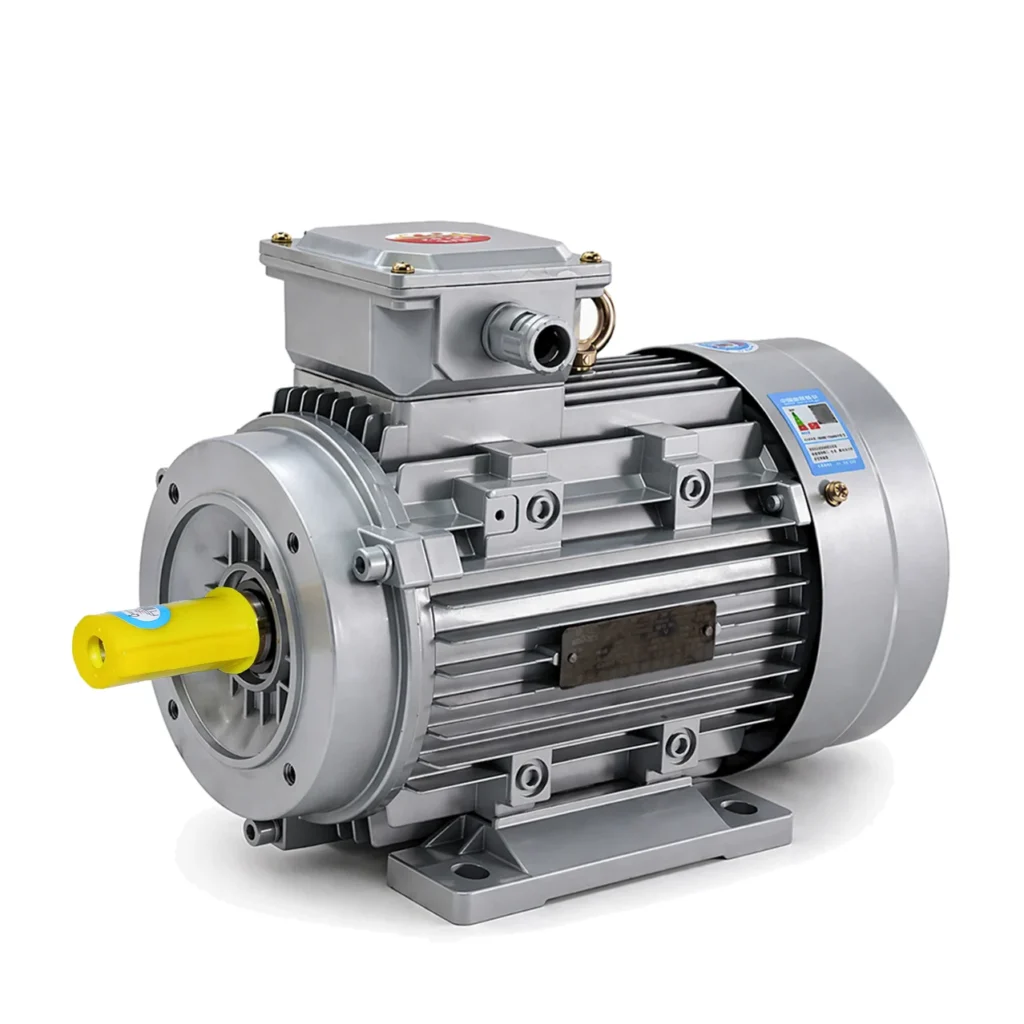




Replacing an IE3 induction motor with an IE4 motor can reduce energy losses in industrial equipment. However, a higher efficiency class does not automatically make the new motor a direct replacement. Mechanical dimensions, rated speed, starting current, operating conditions and the existing electrical installation must all be considered.
At Yaoda Motor, we manufacture YE3 IE3 and YE4 IE4 three-phase induction motors for industrial machinery and replacement applications. Our published technical data show why two motors with the same power, pole count and IEC frame designation may still require different installation and electrical checks.
For a replacement project, the objective is not simply to install a more efficient motor. It is to achieve the expected energy saving without introducing coupling problems, unsuitable starting conditions or changes in equipment performance.
IE3 vs IE4 Motor Specifications: Comparing Yaoda YE3 and YE4
The following comparison uses two four-pole, 5.5 kW motors from our published YE3 and YE4 technical tables. Both models are listed with a rated voltage of 380 V.
| Specification | YE3-132S-4 (IE3) | YE4-132S-4 (IE4) |
|---|---|---|
| Rated Power | 5.5 kW | 5.5 kW |
| Frame Size | 132S | 132S |
| Poles | 4 | 4 |
| Rated Speed | 1460 r/min | 1470 r/min |
| Efficiency | 89.6% | 91.9% |
| Rated Current | 11.2 A | 11.4 A |
| Power Factor | 0.83 | 0.80 |
| Locked-Rotor Current / Rated Current | 7.9 | 9.5 |
| Published Weight | 70 kg | 100 kg |
Data source: Yaoda Motor YE3 and YE4 published performance tables. Values refer to the listed configurations and should be confirmed against the approved specification before ordering.
The YE4 model has a higher rated efficiency, but its published data also show a slightly higher running speed, a different power factor and a higher locked-rotor current ratio. The listed weight is also greater.
These differences explain why an IE3-to-IE4 replacement should be evaluated using the complete technical specification rather than the efficiency class alone.
Check IEC Frame Size, Shaft Dimensions and Mounting Compatibility
Mechanical compatibility is the first requirement for a successful motor replacement.
Both YE3-132S-4 and YE4-132S-4 use the 132S frame designation. This is a useful starting point, but it does not establish that every installation dimension, accessory or overall clearance is identical.
For a foot-mounted motor, we review shaft centre height, mounting-hole spacing, shaft diameter, shaft extension and keyway dimensions. Flange-mounted motors also require confirmation of the flange register, bolt circle and associated dimensions.
The checks become especially important when a motor is directly coupled to a pump, gearbox or compressor and there is little room for adjustment.
Mechanical Dimensions Required for Replacement
| Item | Required Check |
|---|---|
| IEC Frame | Frame designation and shaft centre height |
| IMB3 Mounting | Foot mounting-hole spacing and mounting height |
| IMB5 Mounting | Flange diameter, register and bolt pattern |
| IMB35 Mounting | Combined foot and flange dimensions |
| Motor Shaft | Diameter, extension, keyway and coupling fit |
| Overall Dimensions | Motor length, cooling clearance and terminal-box position |

Our precision manufacturing workshop carries out machining operations for shafts, end covers, bearing seats and other mechanical components. These processes support dimensional consistency, but the approved motor drawing remains the reference for confirming installation compatibility.
The dimensional tables for our YE3 IE3 induction motors and YE4 IE4 induction motors provide the information needed for an initial comparison.
For a direct replacement, we recommend checking the proposed motor drawing against the existing installation before confirming the order.
Will the Higher IE4 Motor Speed Affect the Driven Equipment?
An IE4 motor may operate at a slightly different rated speed from an IE3 motor with the same number of poles.
For example, our published data list the YE3-132S-4 at 1460 r/min and the YE4-132S-4 at 1470 r/min. The difference is approximately 0.68%.
For a centrifugal pump or fan operating at a fixed speed, this difference may change the equipment's operating point. Under the usual affinity-law assumptions, flow is approximately proportional to rotational speed, pressure or head varies with the square of speed, and shaft power varies with the cube of speed.
Using the published speeds:
Speed ratio = 1470 / 1460 = 1.00685
Approximate shaft power ratio = (1470 / 1460)³ = 1.0207
This represents a theoretical increase of approximately 2.1% in shaft power under comparable operating conditions.
Actual results depend on the pump or fan curve, system resistance and operating point. The calculation illustrates why a small motor-speed difference should not be ignored when evaluating energy savings.
For conveyors, mixers and other mechanical drives, the review instead focuses on operating torque, transmission ratio, starting requirements and the permissible speed range.
Check Starting Current and Motor Protection Settings
Starting current is another important consideration when replacing an IE3 motor with an IE4 motor.
The published locked-rotor current ratio for our YE3-132S-4 is 7.9, compared with 9.5 for the YE4-132S-4.
Using the listed rated currents, the approximate locked-rotor current values are:
- YE3-132S-4: 11.2 A × 7.9 = 88.5 A
- YE4-132S-4: 11.4 A × 9.5 = 108.3 A
These are calculated locked-rotor current values based on published ratios, not measured starting-current waveforms. Actual starting conditions depend on the supply, starting method, connected load and acceleration period.
The difference is nevertheless relevant when reviewing the existing starter, contactor, protective devices, cables and available electrical supply capacity.
It is also important to note that the YE4 model has a slightly higher published rated current despite its better efficiency. This is associated with the difference in power factor between the two configurations.
For that reason, overload protection and other settings should be reviewed against the new motor nameplate rather than copied automatically from the existing motor.
How Much Energy Can an IE4 Motor Save?
The potential energy saving from an IE3-to-IE4 replacement can be estimated by comparing the electrical input required to deliver the same shaft output.
For the 5.5 kW models above, the calculation at rated output is:
| Calculation | Result |
|---|---|
| YE3 Input Power: 5.5 / 0.896 | 6.138 kW |
| YE4 Input Power: 5.5 / 0.919 | 5.985 kW |
| Input Power Difference | Approximately 0.154 kW |
| Annual Operation | 6,000 hours |
| Estimated Annual Saving | Approximately 922 kWh |
This calculation assumes both motors deliver the same 5.5 kW shaft output continuously under the stated efficiency conditions.
It is an engineering estimate rather than a guaranteed annual saving. Actual energy consumption depends on load variation, operating hours, voltage conditions and changes in driven-equipment performance.
For continuously operated equipment, the estimated electricity saving should be compared with the purchase price, installation cost and any necessary electrical or mechanical modifications.
When Is an IE3 to IE4 Motor Replacement Suitable?
Pumps and Fans
Check the required shaft power, actual operating speed, installation dimensions and available motor power margin. For centrifugal equipment, a change in speed may affect flow, pressure and shaft power.
Conveyors and Mechanical Drives
Review starting torque, acceleration requirements, duty cycle and gearbox compatibility. A higher efficiency class does not by itself confirm that the replacement motor is suitable for a heavily loaded start.
Compressors
Confirm the starting method, load characteristics, coupling arrangement and motor thermal requirements. The replacement must remain compatible with the compressor's starting and continuous operating conditions.
Variable-Frequency Applications
When the existing motor operates with a frequency converter, the replacement assessment must also consider inverter output characteristics, winding insulation, cooling at reduced speed and the intended operating frequency range.
An IE4 efficiency classification alone does not establish suitability for all inverter-driven applications. The motor configuration should be selected according to the actual operating requirements.
How Yaoda Motor Reviews IE3 to IE4 Replacement Requirements
Our YE3 and YE4 motor ranges are supported by published electrical performance and installation data. These specifications provide a basis for reviewing rated power, pole count, voltage, current, efficiency, mounting dimensions and other requirements.
We also consider the mechanical construction and manufacturing requirements associated with the selected motor configuration.
Stator Winding and Insulation Processing
Our wire embedding workshop handles stator winding, coil insertion, insulation processing and preparation of semi-finished stator assemblies. These manufacturing operations are part of producing reliable industrial induction motors.

For a motor replacement, manufacturing capability is relevant to the review of winding configuration, mechanical fit and project-specific requirements. Any non-standard electrical or mechanical specification must be confirmed before production.
Electrical Performance and Testing
Our factory includes a motor type-testing area with equipment for evaluating electrical and mechanical performance. The published factory information covers load testing, efficiency verification, temperature-rise assessment, vibration, noise and insulation-related testing.
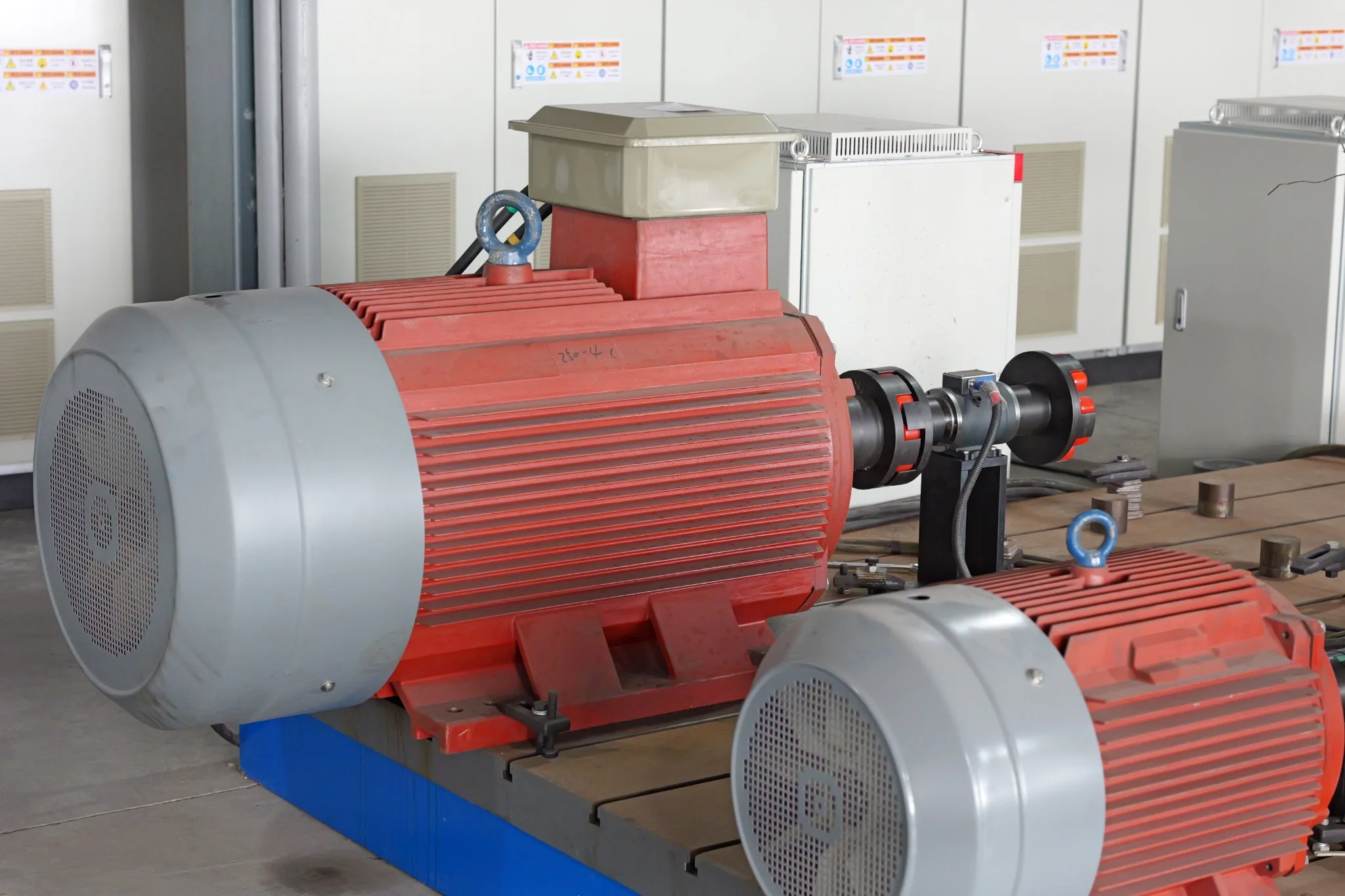
Testing requirements and the documents supplied for a specific order should be confirmed according to the selected motor and project specification.
Further details of our manufacturing operations are available on the Yaoda Motor factory page.
Information Required for an IE3 to IE4 Motor Replacement
To review a replacement configuration accurately, we recommend providing the existing motor nameplate and the following information:
- Existing motor manufacturer and model
- Rated power, voltage and frequency
- Rated speed or pole count
- IEC frame size and mounting arrangement
- Shaft diameter, extension and keyway dimensions
- Driven equipment and operating conditions
- Starting method or frequency-converter details
- Required quantity and any project-specific specifications
For non-standard motors, an existing installation drawing or shaft drawing is particularly useful. These details allow the proposed motor configuration to be reviewed against the original installation before an order is confirmed.
Frequently Asked Questions About IE3 to IE4 Motor Replacement
1. Can an IE4 motor directly replace an IE3 motor?
An IE4 motor can replace an IE3 motor when the rated output, mechanical dimensions, operating speed, starting characteristics, electrical supply and application requirements are compatible. Equal power and IEC frame size alone do not establish interchangeability. We recommend checking the relevant YE3 and YE4 performance and dimensional data before confirming the replacement.
2. Are IE3 and IE4 motors with the same IEC frame size interchangeable?
Not automatically. The same IEC frame designation provides a common dimensional reference, but the shaft extension, flange arrangement, overall length, terminal-box position and other construction details still require verification. The approved dimensional drawing should be used for final installation confirmation.
3. Does upgrading from IE3 to IE4 require a different motor starter?
Not necessarily. The existing starter may remain suitable if its ratings and the supply conditions are compatible with the new motor. However, the locked-rotor current ratio and acceleration requirements must be checked. Our published 5.5 kW YE3 and YE4 examples have different starting-current characteristics, so the starter and protection settings should be reviewed.
4. Will an IE4 motor always reduce electricity consumption?
At the same shaft output and comparable operating conditions, a motor with higher efficiency requires less electrical input. Actual annual savings depend on the load profile, operating hours and driven equipment. For fixed-speed pumps and fans, a change in running speed can also change the required shaft power and should be included in the calculation.
5. Can a 50Hz IE3 motor be replaced with a 60Hz IE4 motor?
The voltage, frequency, rated speed and load requirements must be assessed together. A 60Hz configuration is not automatically interchangeable with a 50Hz motor. Suitability depends on the approved electrical specification and the operating requirements of the driven equipment.
6. What information is needed for an IE3 to IE4 replacement quotation?
We recommend providing the existing motor model, nameplate photograph, rated power, voltage, frequency, speed, mounting arrangement, shaft dimensions, application and quantity. For non-standard installations, the original motor drawing helps us review the proposed replacement configuration more accurately.
Request an IE4 Motor Replacement Review
An IE3 to IE4 motor upgrade should improve operating efficiency without introducing mechanical, electrical or performance problems.
Yaoda Motor manufactures YE3 and YE4 three-phase induction motors for industrial machinery, equipment manufacturers, distributors and replacement projects. We can review the available motor specifications and discuss the requirements for a suitable configuration.
For motor replacement or OEM requirements, please contact Yaoda Motor with your existing motor nameplate, dimensional information and project details.